Data
Data on internet activity worldwide
(hostcount)
One of a series of analyses
by
Giancarlo Livraghi gandalf.it
Updated Feruary 29, 2012
Based on statistics
up to December 2011
The next update will probably be here
in
March 2013
Data on internet activity worldwide
(hostcount)
One of a series of analyses
by
Giancarlo Livraghi gandalf.it
Updated Feruary 29, 2012
Based on statistics
up to December 2011
The next update will probably be here
in
March 2013
| This analysis is updated according to international data for the second half of 2011 (published on February 14, 2012) For more detailed information concerning Europe see European data Data for previous periods were reported in issues 8 15 24 31 38 43 50 56 61 62 65 68 70 74 77 80 of the Netmarketing newsletter |
A short note on method
The hostcount analysis is based on the Internet Domain Survey. The most recent IDS update (June 2011) was published in September 2011. “Hostcount“ is the number of internet hosts in each country. Of course that relates to the country in which an internet domain is registered. not necessarily to the physical location of the server. A host is an active and permanent IP number. i.e. a functioning service directly connected to the internet.
This is the growth of hostcount from 1981 to 2010 according to the worldwide internet domain survey.
1981 – 213
1982 – 235
1983 – 562
1984 – 1,204
1985 – 1,961
1986 – 5,089
1987 – 28,174
1988 – 80,000
1989 – 159,000
1990 – 376.000
1991 – 727,000
1992 – 1,313,000
1993 – 2,217,000
1994 – 5,846,000
1995 – 14,352,000
1996 – 21,819,000
1997 – 29,760,000
1998 – 43.230,000
1999 – 72,398.000
2000 – 109.574,000
2001 – 147,345,000
2002 – 171,638,000
2003 – 233,101,000
2004 – 317,646,000
2005 – 394,992,000
2006 – 433,193,000
2007 – 541,677,000
2008 – 625,226,000
2009 – 732,740,000
2010 – 818,374,000
2011 – 888,239,000
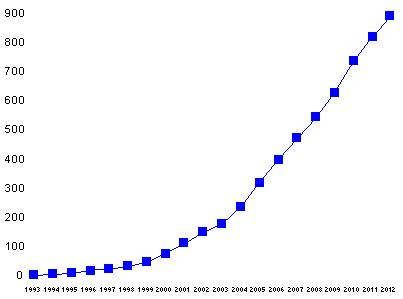
This graph shows growth from 1992 to 2011.
Internet hosts 1992-2011
Numbers in millions
Growth continues, but it can not be defined as a “logical curve“. It’s a combination of many different trends. Overall it’s quite fast. The size of online activities worldwide has increased tenfold in eleven years and has doubled in the last five.
This table summarizes growth from 1994 to 2011.
Number
of hosts% growth in six
monthsin a year December 1994 * 5,846,000 51.1 118.9 June 1995 * 8,200,000 40.3 106.8 December 1995 * 14,352,000 75.0 145.5 June 1996 * 16,729,000 30.5 104.0 December 1996 * 21,819,000 29.9 52.0 June 1997 * 26,053,000 19.4 55.7 December 1997 29,670,000 13.9 36.0 June 1998 36,739,000 23.8 41.0 December 1998 43,230,000 17.7 45.7 June 1999 56,218,000 30.0 53.0 December 1999 72,398,000 28.8 67.5 June 2000 93,048,000 28.5 65.5 December 2000 109,574,000 17.8 51.4 June 2001 125,888,000 14.9 35.3 December 2001 147,345,000 17.0 34.5 June 2002 162,128,500 10.0 28.8 December 2002 171,638,300 5.9 16.5 December 2003 233,101,500 n.a. 35.8 June 2004 285,139,100 22.3 n.a. December 2004 317,646,000 11.4 36.3 June 2005 353,284,000 11.2 23.9 December 2005 394,992,000 11.8 24.3 June 2006 439,286,000 11.2 24.3 December 2006 433,193,000 – 1.3 9.7 June 2007 489,774,000 13.1 11.5 December 2007 541,677,000 10.6 25.0 June 2008 570,938,000 5.4 16.6 December 2008 625,226,000 9.5 15.4 June 2009 681,065,000 8.9 19.2 December 2009 732,740,000 7.6 17.2 June 2010 768,913,000 4.9 12.9 December 2010 818,374,000 4.0 11.7 June 2011 849,870,000 3.8 11.8 December 2011 888,239,000 4.5 8.6
* The survey system changed in January 1998.
1994-1997 data are adjusted to fit the new criteria,
1994 percentages over 1993 are based on the “old“ survey.From 1987 to 2007 the survey has been published twice a year,
but only year-end figures were available for 2003.The real increase in 2006 was much larger than it appears in these figures. As pointed out at the beginning of this report, the hostcount results for some domain categories had changed and the outcome concerned mainly, if not exclusively, the United States. The technical reasons for this aren’t clear, but it’s pretty obvious that in the rest of the world there was a 33 percent increase of hostcount in 2006 over 2005 – with a worldwide average close to 25 percent (also in the United states actual online activity continued to grow. probably bewteen 18 and 20 percent each year.)
In previous periods. as total numbers became larger, growth percentages decreased until 1997. There appeared to be a new acceleration in 1999 but it wasn’t confirmed in 2001 and 2002. Growth was faster in 2003 and 2004. A 24 percent increase in 2005 was remarkably high and real development in 2006-2007 continued with approximately the same speed. In following years growth percentages have been decreasing, as was to be expected – but development continues to be quite strong. Though no forecasts or projections can be reliable, it doesn’t seem unlikely that the worldwide total may reach a billion hosts in 2013.
The next table analyzes data for the 51 countries (of 240) that have over 800,000 internet hosts.
Number of hosts
December 2011Per 1000
inhab.United States 450,165,000 1458.0 Japan 63,465,680 495.6 Germany * 30,000,000 365.6 United Kingdom * 27,000,000 436.2 France * 26,000,000 399.8 Italy 25,455,561 419.9 Canada * 24,500,000 712.7 Brazil 23,789,506 124.7 China 19,771,904 14.8 India * 18,500,000 15.3 Spain * 17,000,000 362.8 Australia 16.952.338 724.5 Mexico 15,165,150 135.0 Russia 13,757,722 96.9 Netherlands 13,715,032 823.5 Poland 12,928,122 338.6 Argentina 10,927,967 272.6 South Korea * 10,000,000 205.8 Taiwan 6,405,566 276.6 Sweden 5.806,123 616.6 Switzerland 5,249,367 667.3 Belgium 5,179,959 494.3 South Africa 4,834,779 96.7 Finlandia 4.699.507 874,3 Denmark 4.284,533 770.5 Colombia 4,281,046 94.1 Czech Repub. 4,140,126 393.1 Turkey 4,034,284 54.7 Portugal 3,664,339 341.4 Norway 3,583,945 728.4 Austria 3,444,552 411.3 Thailand 3,277,550 50.3 Greece 3,114,925 275.5 Hungary 3,063,519 305.9 New Zealand 3,027,638 693.1 Romania 2,715,415 126.5 Israel 2,185,740 282.8 Ukraine 1,997,268 43.7 Singapore 1,932,116 512.2 Chile 1,853,927 108.5 Slovakia 1,387,022 255.2 Ireland 1,379,364 300.9 Croatia 1,344,819 305.0 Indonesia 1,341,930 5.7 Lihtuania 1,189,700 345.3 Serbia 1,106,234 150.6 Uruguay 945.,826 281.7 Bulgaria 937,195 127.5 Venezuela 888,028 30.3 Hong Kong 861,516 123.0 Estonia 848,009 656.8 World 888,239.420 66,7
Figures for the United States are “weighted ” approximately to account for the fact
that some of the “apparently American” domains are in toher countries.
This applies also to the graphs.
Worldwide density is based on hostcount and population excluding the U.S.* Figures for Germany, the UK, France, India, Canada, Spain and South Korea are “arbitrarily
but not unreasonably” adjusted to compensate for underestimated hostcount data in this period.
** The number for Sweden includes hosts on “.nu” domains as well as “.se”.
There is considerable growth in several European countries and in other parts of the world. Trends need always to be understood over more extended periods, but there are some relevant changes, as in the case of France (that had overtaken Australia in 2004 and the Netherlands in 2006). Poland in recent years has moved ahead of some traditionally strong countries. Russia is growing faster since 2009.
Brazil has consistently fast growth. So did Mexico in 2006-2008 (not as fast in following years, but still quite strong). Other countries in Latin America, and several in Asia, as well as some in Africa, are showing considerable development.
A “sudden” change in the second half of 2007 was a huge increase of hostcount in China. The beleivability of such a “leap” is questionable. It will take more years to understand if something is really changing – and, if so, what and how. (See the report on Asia.)
Now fortyfsix countries worldwide have over a million internet hosts (seven in the Americas, ten in Asia, two in the Pacific, twentysix in Europe and one in Africa.) Twentytwo (eleven in Europe) are over five million and seventeen (eight in Europe) over ten.
If we look beyond national borders there are two large language communities online: Spanish and Chinese (there is a specific document in Italian that explains this subject.)
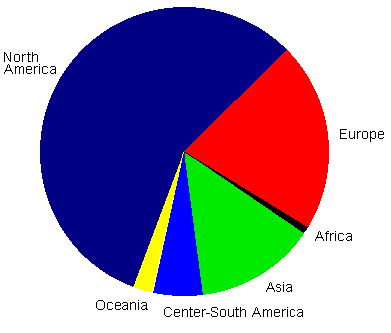
This graph shows the situation by “large geographical areas”.
Large geographical areas
There are changes, but the general picture doesn’t look very different compared to past years. The internet isn’t “global”. A large part of the world has scarce access. North America and Europe, with 19 percent of the population, still have 74 percent of the worldwide activity on the internet.
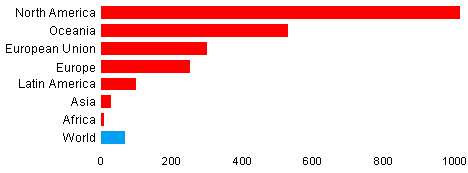
The continent (outside North America) with the highest density is Oceania-Pacific, that has 500 internet hosts per 1000 inhabitants. The index in Europe is 250. In Latin America it is 96 (it became higher than the world average in 2006.) In Asia 27 and in Africa 6 per thousand. As we see in this graph.
Internet hosts per 1000 inhabitants
If we remove from the data the “dominating“
hostcount of individual countries in two continents,
excluding Japan density is 12 hosts
per thousand inabitants in the rest of Asia
and exluding South Africa it’s 1 in the rest of Africa.
(See comparisons in the analyses for Asia and Africa).
There are also big differences inside each of the areas. 95 percent of the net in North America is in the United States. 99 percent of the net in Oceania (Pacific) is in two countries, Australia and New Zealand. Half of Asia is in Japan (less than a quarter in the Chinese ethnic area). 80 percent of Africa is in South Africa, 80 percent of central-south America is in Brazil and Argentina. Only in Europe no country has more than 17 percent of the total, but there are considerable differences, as explained in the analysis of European data.
In December 2011, compared to a year earlier, there was 9 percent growth in North America, 8 percent in Europe, 9 percent in Asia, 8 percent in Oceania, 28 percent in center-south America. There was a remarkable 70 percent growth in Africa in 2010, but most of it was in one country, South Africa – and anyhow on a much smaller scale than the rest of the world.
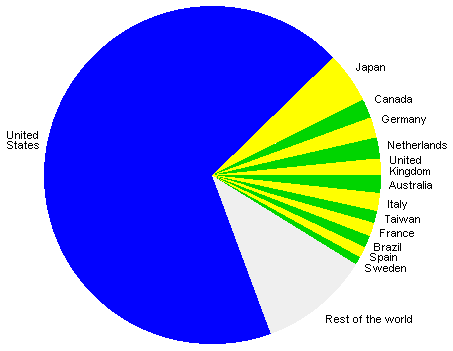
The percentage of the United States on the world total has decreased in recent years, but it remains dominant. To understand how the picture is changing, this graph shows the situation as it was ten years ago (countries with over a million internet hosts at the end of 2001.)
13 countries – 2001
The US share, that has always been large, had increased at that time.
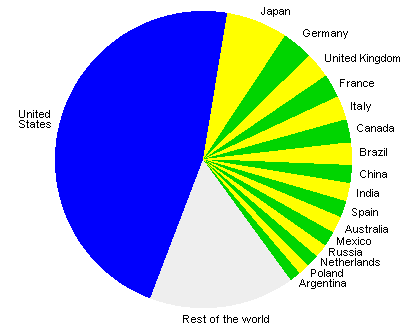
The next graph shows an update of the same picture in the most recent data (countries with over ten million internet hosts in December 2011.)
17 countries – 2011
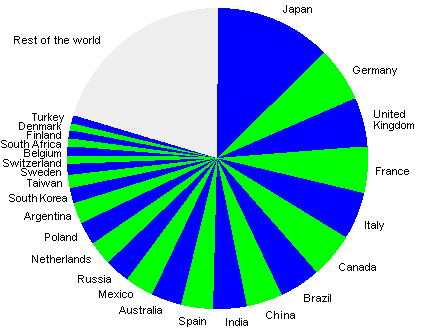
If, for better readability, we exclude the United States, this is the picture for the other 27 countries with over four million internet hosts.
27 countries – 2011
There were some relevant changes in recent years, with growth of some European countries, a stronger presence of Brazil and Mexico and new developments in China and India. But over a third of the internet outside the United States remains concentrated in five countries that have six percent of the world’s population.
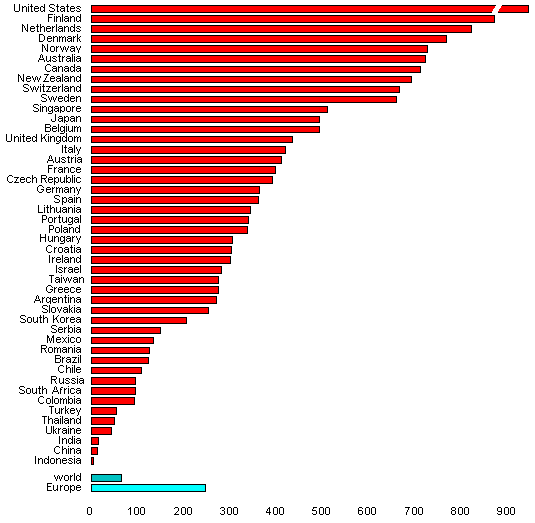
The next graph shows density (hosts per thousand inhabitants) in 46 countries worldwide that have over a million internet hosts.
Internet hosts per 1000 inhabitants in 46 countries
The size of the United States is reduced by 35 % for better redability of the graph,
The United States caught up with Finland in 1998 and gained a growing lead in following years, also in density as related to population. Traditionally strong countries, as in the case of Scandinavia and the Netherlands, still have fast growth. Development continues in Eastern Europe, with a particularly strong increase in Poland and in the Czech Republic.
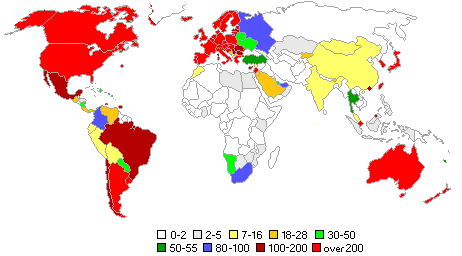
It’s interesting to look at density worldwide as a map.
Internet hosts per 1000 inhabitants
Somewhat arbitrarily, the density area in this map
covers only part of the Russian federation
because it’s reasonable to assume that online activity
is concentrated mostly in European Russia
A few small islands in the Pacific with a relatively
high hostcount are not shown in this map
Situations in several countries have changed in recent years. For instance in 2002 there were three countries with more than 200 internet hosts per thousand inhabitants (the United States, Finland and Iceland) and now they are over forty. But the general picture remains the same.
The “globality” of the internet is limited to part of the globe. Extended use of the net is still concentrated on the two sides of the North Atlantic – and in a few countries in East Asia, the Middle East and the Pacific. There is fast evolution in Latin America, but it’s still behind the northern end of the American continent and most of Europe. Large parts of the world still have minimal (if any) access to communication networks.
Four documents in the “data” section
contain detailed maps of
Europe Asia Africa Latin America
In three other documents there are analyses
of the internet in Europe, Asia and Africa